

The Porter Turret Restoration,
Present Status and Future Operation
by Jim Daley, Springfield Telescope Makers
On first seeing the Porter Turret in 1959 my first thoughts centered around the instrument’s concept put forward by its inventor. It was clear that the design was driven by Porter’s desire to view comfortably indoors, a dream of many amateurs, even today. I affectionately called the turret an “inside-out Newtonian” configuration, that is, the diagonal mirror defined the maximum aperture possible and the perforation took the place of the normal diagonal, but still defined the un-vignetted field! Porter had previously played with this idea, but the stroke of genius is in the mounting arrangement which combine the two perpendicular motions of right ascension and declination in his now familiar reflecting type turret form. He was, no doubt, influenced by the much older Hartness Turret Telescope just “down the street” near the center of Springfield.
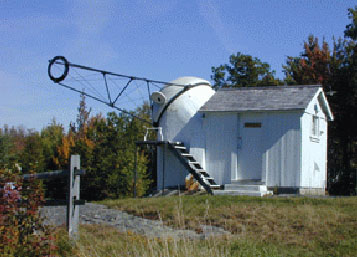
After attending a few Stellafane conventions and having many conversations with the Springfield Telescope Makers club members, a view of the instrument’s condition slowly emerged. I noticed at each convention that the turret always seemed to have a problem and observers could only get a fleeting view of objects, when and if they could be found. This state of affairs really perked up my interest as the design was fundamentally sound, thus there was no reason why Porter's dream could not be realized in full measure, delighting future observers. In 1969 I made a mental list of the telescope’s problems including the following.
- The clock drive was totally inadequate as the speed regulation was nonexistent.
- The gear box clutch was slipping badly and leaking oil all down the north side face of the observatory (Visible in the page header image -- Webmaster).
- Somehow the fast slewing mechanism had gone very wrong inside the gearbox and the oil in the bottom of the case was contaminated with large aluminum chips. Also, if the observer forgot to remove the manual slewing crank he would be in danger of breaking a bone or two when the powered slew was engaged.
- The friction roller, which drives the polar axis dome, was also slipping.
- Images in the scope were not well formed, although, impressive enough to see the real possibilities. Further investigation revealed that the 16-inch flat had a turned down edge of about 1/4 wave (surface) and the 16-inch primary also exhibited a similar problem. Many observers complained of astigmatism, but after I viewed with the instrument for a while one night it dawned on me that it was not astigmatism but simply the in and out of focus pattern you would expect when a 16-inch primary is illuminated by a 11.3 x 16-inch elliptical beam reflecting from the 45 degree 16 inch circular declination flat. The elongated pattern remained in the same orientation on both sides of focus, mystery solved.
- The roof was leaking and the dome’s concrete was cracking.
The project to bring the turret telescope to full operational status and to finally realize Porter’s dream began in 1972 with a simple but important task, shingling the observatory roof. The original roof was tar-papered and gave the building a cheap, shack-like appearance (Note this in the page header image also -- Webmaster). I suggested a nice wood shingle covering and got club approval for this change. The effect was dramatic with the observatory looking neat as a pin.
About this time I met Allan Rohwer who joined the effort to restore the turret. After Bert Willard and I finished shingling the roof Al suggested we take out the gear box and examine it and determine a course of repair. With the gearbox removed we disassembled it and cleaned all the parts of metal chips, grit & sludge. The clutch mechanism is of the multi-plate type actuated with a simple over-center cam engagement and lock. It became clear that the slewing mechanism should be permanently disabled as it placed far to much strain on all the parts and besides the manual slew with the hand crank worked smoothly and safely.
Along about this time, Mike Heleba and Charlie Thayer joined the team and things like the offset slew crank was replaced with a nice hand wheel from a large machine tool. The original drive motor was an induction single phase AC type and thus the speed regulation was poor. We found a surplus variable speed frequency controlled gear reduced motor drive unit and obtained a suitable flex coupling. The gearbox was installed and the new drive attached. All worked well except for the occasional slipping of the friction drive roller. Porter must have had a way of loading the roller against the RA internal ring surface to prevent slippage and yet the gear box had no such provision. I was examining the RA support rollers and noticed that the hex headed bearing studs were eccentric to the center drilled holes used in lathe turning the shafts. One simple conclusion: the rollers are eccentrically mounted and sure enough by turning the pinion with a very big socket wrench the dome could be gravity loaded to any desired value onto the drive roller. The RA axis now drove very well indeed. At some early point in all this work I was invited to be a member of the STM’s. This was indeed an honor and I accepted and after a year as candidate member was voted in as full member and have been active, as time permitted, to the present day. Al followed closely my path and he too has been a member to this day (2006) as well.
The next job was the optics. The first question was should we re-figure the old optics (it was during the drive repair that I determined the optical quality of the flat & primary). It was decided not to touch the historically important plate glass Porter optics but, instead, obtain blanks of Pyrex and make a new set. Now here is where I decided, popularly or not, to have a round (circular) aperture of 12-inches and this could be nearly done with a flat of 16-inches (16 /1.414 = 11.3-inches). The slight curving unilluminated segments on opposite diameters are nearly impossible to see extra-focally and have absolutely no adverse affect on the Airy pattern. We were lucky to have a 16-inch Pyrex blank for the flat and a 12-inch Cer-Vit1 blank for the primary donated and immediately went to work on them both. The Flat presented a special problem i.e. it had to be thinned from 3-inches to 1.5 -inches to enable it to be physically handled (the optics are loaded and removed for each observing session) and to fit the existing cell. Also the flat had to be perforated with a 2-inch diameter hole cored at 45 degrees, all this and have a flatness such that the wave-front not be corrupted by more than1/10 wave. Well, that job just about taxed my mirror making skills to the limit, but finally, after 6 months spare time, the job was done. Meanwhile the primary mirror was completed under my direction by one of the best opticians I have ever had the pleasure of knowing, Ken Leathers. Being a telescope maker and planetary observer, Ken knew of the special requirement of planetary telescopes i.e. absolutely smooth optics and he did one fine job on the paraboloidal primary. The final test showed 1/40th wave correction and smoothness better than 1/100 wave.
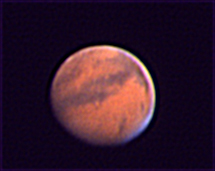
Turret by Bert Willard.
Image recorded Oct 2, 2005.
Mars being well past opposition, had shrunk to an 18 arc sec wide disk.
The primary was aluminized and the 16-inch Porter cell modified to support the smaller size. The telescope was first tested with the flat un-aluminized. The images were deemed perfect. The flat was aluminized and since 1974 the Porter turret has been enjoyed by thousands of visitors, just as Porter would want. Figure 1 shows the porter turret as it appears today.
At the present time (2006) the instrument is used during the annual convention, at club meetings, special star parties, scout groups, and for more serious observing projects, for instance, web-cam imaging of Mars during the 2005 apparition. The 2005 Mars images taken with the Porter Turret by Bert Willard, who employed a Phillips 2Ucam, certainly documents the sharp imaging we have enjoyed over the last 30 years. Figure 2 shows an example image.
The future of the Porter turret is assured because the club’s level of enthusiasm is high and because the instrument’s structure is so well thought out and constructed. The Porter turret remains a lasting testimonial to a great inventive genius who loved the stars and the instruments to reveal them.
1 Cer-Vit is a vitreous ceramic, zero expansion, glass that was produced in the 1970's by Libby-Owens-Ford
Back to the Early History Page