
Building the World's Largest
Schupmann Telescope
by Scott Milligan, Springfield Telescope Makers
Page 7 of 7
Stuffing the tube
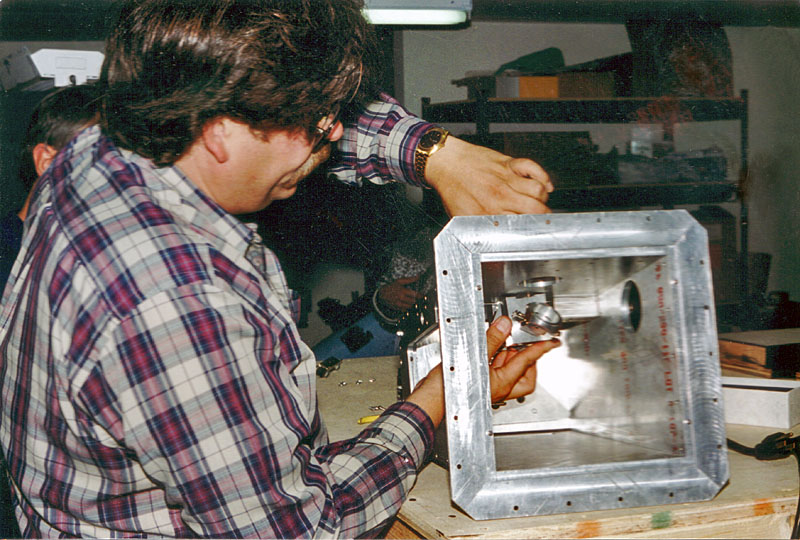
Saturday, October 1994 was to be the date when my basement would host the "tube stuffing party" that would mark the beginning of the final leg of our journey. Prior to that day, I and other STM members were busy designing and making the small mechanical parts for the rear end of the tube assembly.
Jeff Lowe, Chris Houghton, and Arthur Crowe had designed a mechanism that would allow the observer to switch between to different focusers, without losing collimation. The design had flowed down from my wish list and overall layout, through Chris's assembly and detail drawings, and into the machine shops of Jeff, Art, and Dave Kelly, who had made the many small parts that would make the mechanism work. Meanwhile, I prepared the existing aluminum parts for anodizing by sanding the un-machined surfaces with an orbital sander. That Friday evening, Tom Spirock , Jim Flood and Maryann Arrien arrived from New Jersey, with the monster wooden tube loaded into the back of Tom's truck.
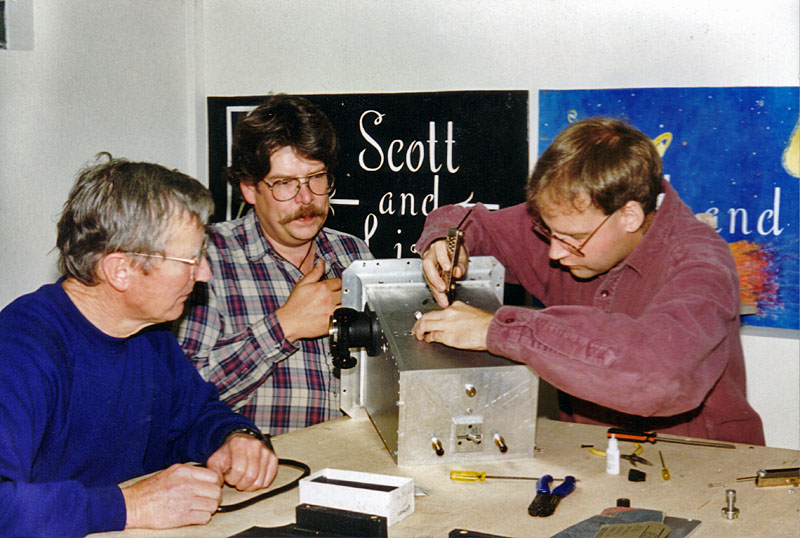
assemble the tailpiece.
As Saturday Dawned, Spirits were running high, which was fortunate, since our very first task would prove the need for teamwork and enthusiasm. Assembling the metal parts that formed the rear end of the tube was a necessary first step, since the optics could not be tested in the tube without providing a means to hold the small folding mirror which allows unobstructed access to the final image. It wasn't long into this effort that we discovered that some of the parts didn't fit together "quite right."
A quick review of the tools available in my basement revealed nothing suitable for metal working, and so Maryann volunteered to drive the errant parts an hour west, where Dave Kelly had the facilities to fix the problem. Meanwhile, the rest of us proceeded with assembling the parts which did fit, cleaning and loading the optics into their cells, and attaching the mounted optics onto the tube assembly. A few hours later, Dave and Maryann returned, and is wasn't long before we discovered other metal parts that needed modification. Dave once again stepped into save the day, machining the necessary changes into the aluminum using a carbide blade on my table saw!
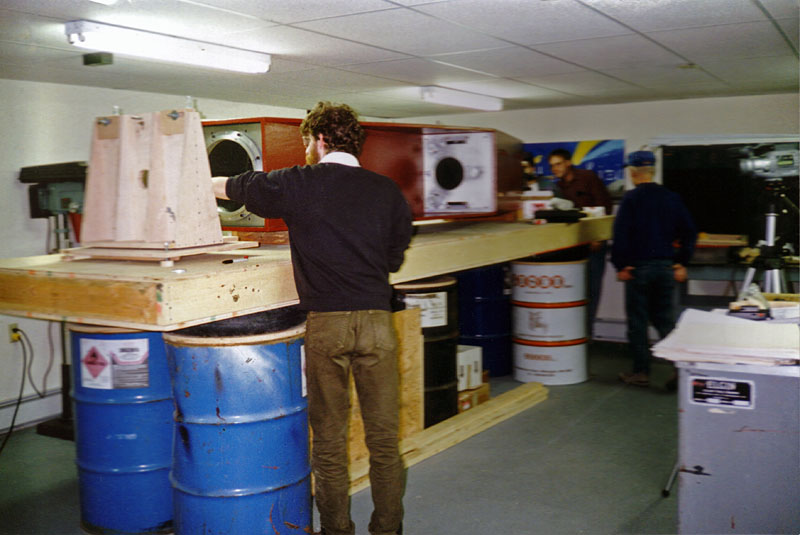 Schupmann Tube on the homemade
floatation bench in Scott Milligan's basement. An auto-collimation flat
is in the stand at far left.
After the focuser cage was assembled, we proceed to install the bulkhead that would mount the main objective lens. To get the spacing between the objective and the M1 field mirror right, we cut a wooden dowel to the length that would span the distance between the field mirror cell and the inside corners of the tube where the bulkhead would be mounted. One end of this rod was held against the center of the field mirror cell while the other was swung from corner to corner at the front end of the tube, so that the four corners where the bulkhead would attach could be marked. This technique proved remarkably accurate; the final alignment of the optics would require insertion of shims only .030 inch thick to set the tilt of the objective that would fully cancel on-axis astigmatism.
By late afternoon, the din and the dust began to settle, and we realized we were ready to begin aligning the optics. Bert Willard and Jim Daley had arrived to offer their assistance. A visual line of sight was used to collimate the optics, and the auto collimating flat was adjusted to return an image through the system. The white source and microscope were used as before to set the proper L2 spacing for zero color. Finally, the LUPI was introduced, and the tilt of the M1 mirror was adjusted to remove all traces of coma. Anxious faces hovered around the video monitor, waiting for the fringe pattern (a Tm's "wheel of fortune") to settle down to tell us whether our efforts had been successful.
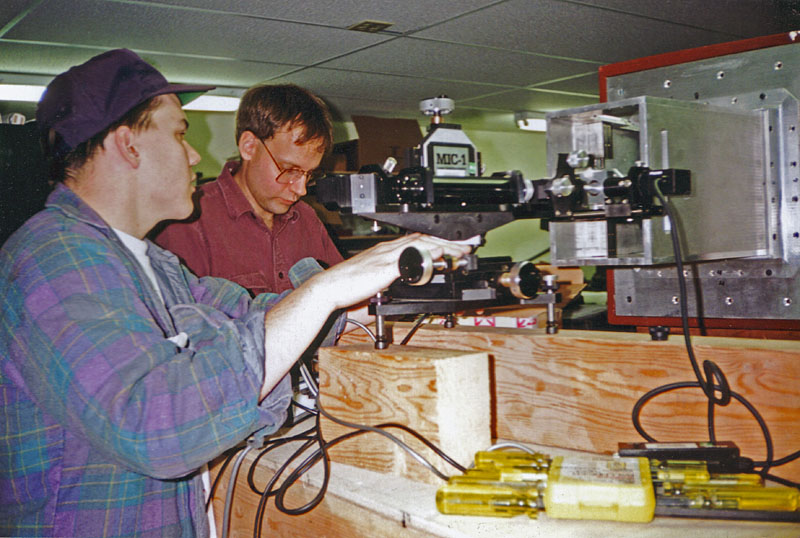
discussing test results at the
eyepiece end of the tube.
A collective shout of victory escaped ten mouths simultaneously when we realized that the fringes were straight and smooth across the entire aperture. As we studied the pattern in detail, however, we noticed something that looked like astigmatism. "Ok," I immediately thought, "we need to adjust the tilt of the main objective." As we proceeded to do this, we noticed that our adjustments were having little or no apparent effect on the fringe pattern. Repeated attempts to remove the astigmatism by adjusting the objective tilt failed to improve the situation. Since it was getting late, it was decided to adjourn in favor of continuing the following day.
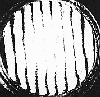
During the overnight hours, several of us realized that stratification of the air path inside the tube could introduce optical path differences which mimicked astigmatism, and that no amount of adjustments to the optical alignment would help this problem. We began work on Sunday by opening the access doors that we had built into the tube. Using a portable fan, we began blowing air into the tube, hoping to create a thorough mixing of the stratified air layers that we suspected were causing the problem. Immediately upon doing this, the astigmatism in the fringe patterns was observed to diminish markedly. After Jim Daley pointed out that the effects of air path stratification would be less severe when the tube was pointed upwards (i.e. at the sky,) we decided to suspend further efforts at refining the alignment in the laboratory; instead, we would complete our alignment on the sky.
First Light
December 1994; the forecast was for overcast skies during the day, giving way to partly cloudy conditions overnight. I was relieved to notice that eight years of dedicated effort had not noticeably disturbed the overall climate for astronomy in New England. People would still want to live here because, unlike most places considered top-notch for astronomy, rain falls often enough that cactus and tumbleweed are successfully out-competed by real plants requiring non-fictional amounts of water to survive. Faith being everlasting, however, we prepared during the day for our first-ever views of the heavens through our new telescope.
The telescope tube and optics were disassembled for transportation to McGregor Observatory, which by now had a functioning roll-off roof and the rudiments of a computer controlled alt-az mounting that would carry the 270 pound tube assembly (and probably a great deal more weight than that) without batting an eyelash. The tube was hoisted ten feet above the floor using a chain-lift slung from the peak of the moving roof; the mounted optics were then carefully reinstalled. Collimation of the optical train was easily accomplished suing the adjustment screws on the M1, L2 and fold mirror mechanisms. Our first terrestrial views confirmed the ability to reach focus with various eyepieces, and provided the first chance to experience tuning the lateral color in and out using the M1 tilt screws. Now, all that was needed was some cooperation from mother nature during the overnight hours.
That night, we did get a few chances to view the sky. The telescope tracking and object acquisition software was not yet fully functional, and so we decided to do our star testing on Polaris, which then proceeded to dance in and out of the clouds all night. After tweaking the L2 spacing to remove a hint of axial color, we observed that the images of Polaris were completely free from detectable color and showed no trace of spherical aberration. The turned up edge alluded to earlier was clearly visible however, as well as a very slight astigmatism.
Problems with clouds and control of the telescope prevented going after either of these problems that evening, but we were satisfied that the basic level of optical quality was quite high. Before calling it a night, we turned our gaze to Saturn. Despite an unfavorably low location on the horizon, images of Saturn at 150x were crisp and quite contrasty, with little of the annoying glare that can accompany the light diffracted by an obstructed aperture. We agreed that we could finally afford to turn our attention away from the optics during the upcoming winter, and concentrate instead on readying the still unfinished observatory building for final inspection and dedication in the early summer of 1995.
Current Status, and Plans for The Future
At the present time, the observatory has been dedicated, and the telescope control system improved to the point where two experienced users can acquire and track objects with only a modest amount of "fudging" the system. Residual astigmatism at the center of the field has been removed by shimming the objective lens tilt, and the turned-up edge has been hidden by masking off the outer 1/4 inch of aperture. Review of the test data suggest that it may be possible, with an accurate mask, to work with all but the outer 1/8 inch of aperture masked.
Currently planned tasks for the immediate future include installation of a precision aperture mask, internal light baffles, focuser upgrade and dew shield to the tube assembly. A parallel effort will address improvements to the telescope control and guidance systems, with near effortless operation by a single observer the eventual goal. Once these improvements are in place, the club plans to acquire a cooled CCD camera, and begin an imaging program. Images acquired with the telescope will be posted on the Stellafane BBS, and on the Stellafane home-page. [Webmaster's Note: We no longer have a BBS system (they have all since given way to the internet); Astrophotos are now posted in our Astrophoto section]
Training of qualified observers is expected to begin after the remaining bugs have been ironed out of the control system.
--Scott Milligan
The author gratefully acknowledges the selfless support for this project given by Mr. Harry Vandermeer, president, and the employees of Optical Systems and Technology, inc. He also thanks Mr. Joseph Nimmerfroh and the Schott Glass company for their generous donation of the glass for the Schupmann lens elements, and the Amateur Telescope Makers of Boston, who agreed early on to fund construction of the tube assembly. Finally, to the membership of the Springfield Telescope Makers, many of whom labored for many years on the construction of the McGregor Observatory without knowing when it would ever be finished, he congratulates their spirit of dedication, perseverance, and commitment without which this project would have proved impossible to realize.
[Webmaster's Note: The larger photos (the one you can click on to enlarge) were added by me in 2009 from scans of photographs I found in the Stellafane Bunkhouse. The original photos (figures 1 through 14) come from an era where screen sizes were much smaller, and I have been unable to find the sources to update them with larger images.]