Stellafane Early History
1923 - 1986
The early history page covers all of the history from the beginning of our club through the purchase of Stellafane East in 1987. See the Modern History page for history from 1987 through the present day or return to the History Main Page.
Jump to a section on this page:
Early Club History
The First Telescope Making Class
The Springfield Telescope Makers were founded in 1923, but their roots go back to 1920 when Russell Porter offered a telescope making class at their place of employment, Jones & Lamson machine tool company in Springfield, Vermont. This extensively researched article describes the class members and what they made, the class location, and miscellaneous photos, poems and blueprints from that time.
The Springfield Telescope Makers Founders
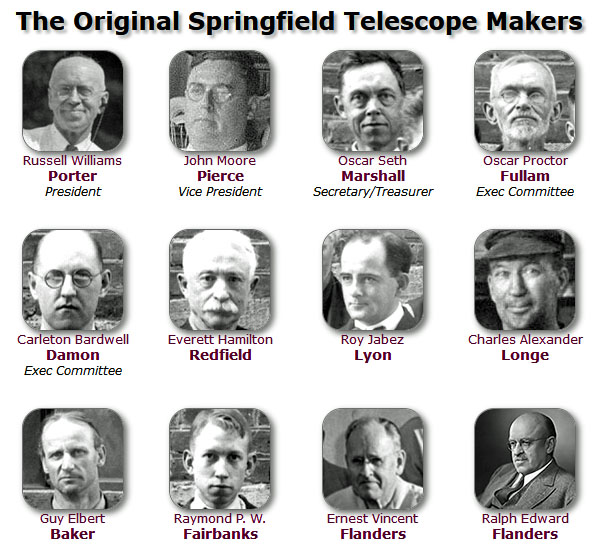
The Founders Page provides information and photos of each of the club's founding members.
This new section is being added to the website in honor of the club's one hundredth anniversary on December 7, 1923. Every few months a new founding member was added to this section, with the final founder being released on our centennial.
An Early Brief History of Stellafane
This article gives a an account of early history of Stellafane through the 1930's.
The Telescope Makers of Springfield, Vermont
Read this 1923 article by Porter, which includes many historic photos.

History of Stellafane 1921 - 1989
This detailed history by club historian Bert Willard consists of four book-length chapters, and provides a comprehensive exposition of the club's history. It does a great job in describing the lean years for the club during and after World War II, and a chapter devoted to the Maksutov Club of the 1950's, which is material that is not currently covered by our other history articles. Since Bert has been an active club member since 1953, many of his accounts are first hand.
Minutes from the First STM Meeting
Read the minutes of the first STM meeting on December 7, 1923. See who the officers were, and what the program for the evening was, including a description of the refreshments (insert gAstronomical society joke here).

About the Stellafane 'Little Man'
by Bert Willard, Club Historian
Stellafane's symbol, the "Little Man" first appeared during the convention on Friday, August 15, 1930. Unfortunately, not much is known of it's creation and/or creator (most likely NOT Russell Porter). What little we do know comes from a report written by a conventioneer named Leo Scanlon. Read his report on the "Little Man" below:
"Pierce had completed the mounting of his transparencies, and brought outside a wrought iron sign made by one of the local boys. We tried different locations for it, and finally decided to hang it directly over the central North Door. It was necessary to bend the lower part of the bracket, which Pierce and I did in the vice in the shop, cutting off the surplus piece at the bottom, which interfered with the opening of the screen door, and securing a ladder, proceeded to nail it up."
Why a Pink Clubhouse?
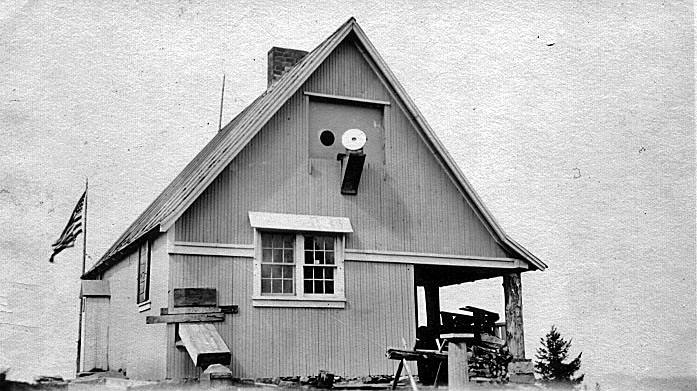
The name Stellafane, originally stellar-fane, is Latin for "shrine to the stars" and was adopted by Russell Porter when the clubhouse was constructed in 1923. It officially refers to only the building but, over the years, has commonly been used to refer to the convention. To avoid confusion, the building was given the unofficial nick-name "The Pink-Clubhouse" for obvious reasons.
Why a "pink" clubhouse? Two stories are told on that subject. The first is that, due to lack of funds upon the completion of the construction of the clubhouse, the club asked a local hardware store owner for a donation of paint. The proprietor agreed so long that he could choose the color which turned out to be "Stellafane Pink" and it's been kept that color ever since. The second is that Russell Porter requested that the clubhouse be painted "spruce-gum pink" which is white with just a tint of pink. Upon his next arrival on the hill he found that the member's misunderstood his request and painted the clubhouse the hot "Stellafane pink" that we see today. Again, thanks to tradition it's still that color today. It's not known which, if either, story is true. Bert Willard, Springfield Telescope Makers Historian
Where was "The Shack"?
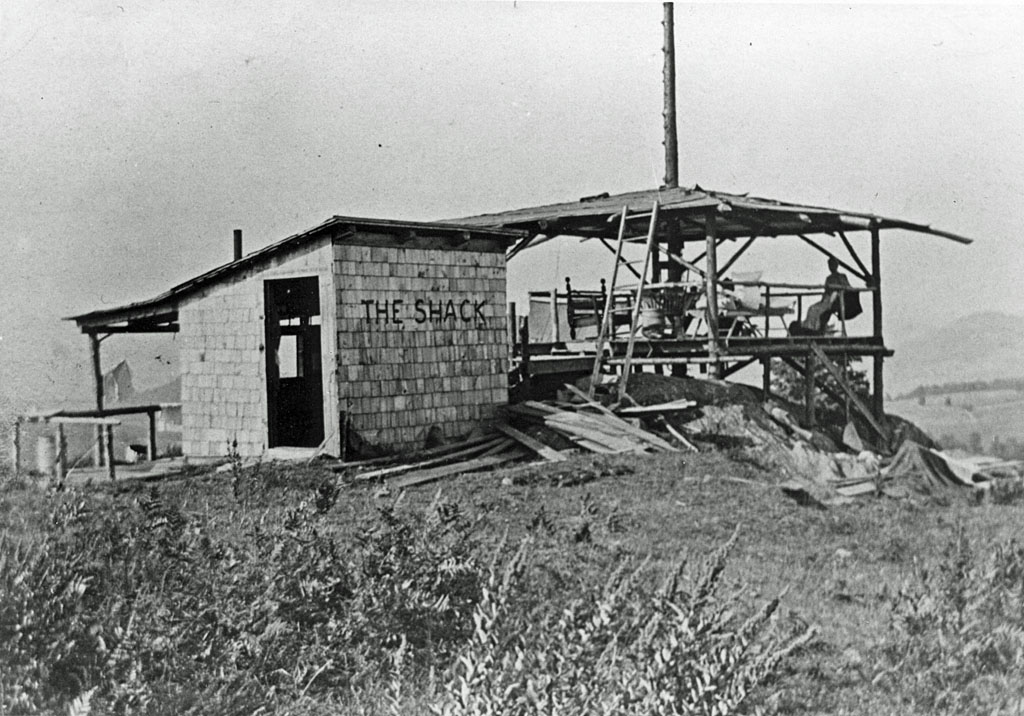
Before the Stellafane Clubhouse was built, Russell Porter was part owner of land on Breezy Hill and a structure known as The Shack, which was a summer retreat. Many assumed The Shack was in the same location as the Stellafane Clubhouse, but recent, thorough research by STM museum curator and historian Matt Considine indicates that is not the case. Land deeds, old photos and historic documents all show The Shack was to the northeast of the current Clubhouse location on land that the club does not own.
In November 2023, Matt presented his findings to the club. You can read this presentation in the PDF file Recovering The Shack Location.
See also the section below:
Observatories & Buildings
Russell W. Porter
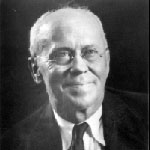
Russell Porter founded the Springfield Telescope Makers. Earlier, he was navigator on several arctic expeditions, and then spent time founding an artists colony in Port Clyde, Maine. Later, he was recruited by Hale and joined the 200-inch telescope project at Palomar in 1928.
Photo taken in 1935.
The Arctic Sketches of Russell W. Porter
This link takes you to the National Archives web site and a 1997 article about the sketches, many of which are in the National Archive collections.
A Polar Explorer Embraces the Simple Life in Maine
This 9 page well illustrated document provides insight into Russell Porter's time in Port Clyde, Maine, where he settled after his artic explorations and before returning to Springfield, Vermont and founding Stellafane. A 9-page pdf document written by Kamissa A. Mort, who grew up summering in Land’s End (Porter's development in Port Clyde).
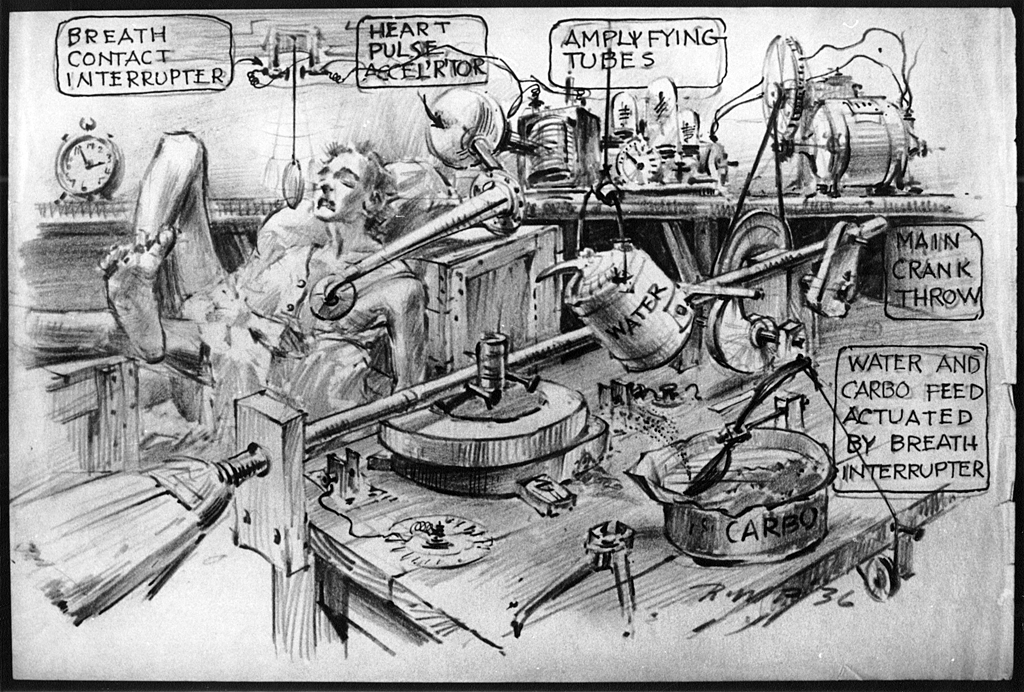
Whimsical Mirror Grinding Machine Cartoon
Porter always seemed to be sketching something, and in this 1936 illustration he created a Rube Goldberg style mirror grinding machine, with a napping amateur providing biometric timing control via heartbeat and breathing.
Glass Working by Heat and by Abrasion
This book, edited by Paul N. Hasluck and published by Cassell and Company in London, 1899, was the book Porter used to teach himself telescope mirror making in Port Clyde. It is available for reading, free, online, by clicking the link.
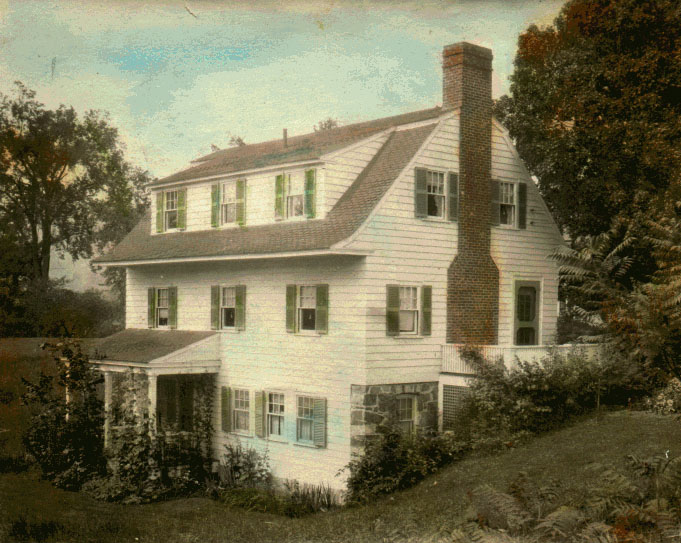
Porter's home in Springfield
A Hand Tinted Photo of 2 Hill Place, Springfield, Vermont. This was the home of Russell W. Porter between late 1919, when he was hired by James Hartness to develop the optical comparator into a marketable product, and 1928, when he was hired by George Hale to work on the 200-inch telescope project.
The Porter Garden Telescope
An article about the development of the Porter Garden Telescope as a consumer product, and it's influence on the design of the 200-inch Palomar telescope.
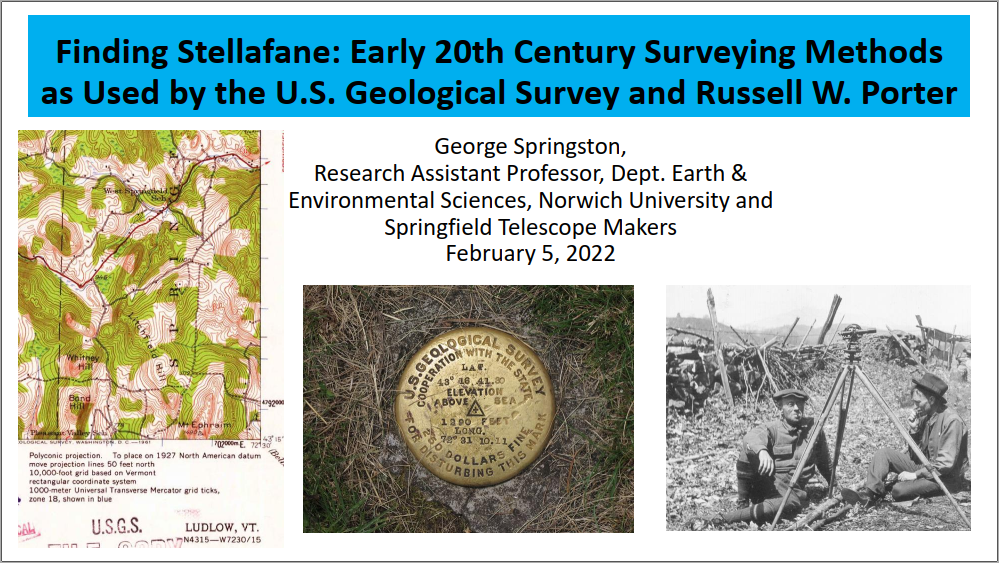
Finding Stellafane: Early 20th Century Surveying Methods as Used by the U.S. Geological Survey and Russell W. Porter [PDF]
A presentation given to the club in February 2022 by STM member George Springston. Describes how mapping was done in Porter's time, the instruments Porter used, and what we know about the Geological Survey marker in front of the clubhouse. Click link to download a PDF of the presentation with speaker notes.
Porter Article in 1928 Vermonter Magazine [PDF]
This article by Oscar Marshall was written as Porter was leaving for Caltech to work on the 200-inch telescope.
Russell Porter's Drawings of Palomar
Porter made these amazingly detailed 3-D drawings of the 200-inch telescope on Mt. Palomar from 2-D blueprints before the telescope was built!
The Story of Palomar
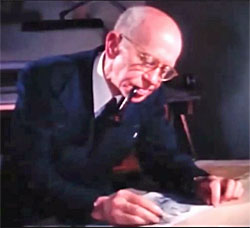
This 1948 film documents the development of the 200-inch Hale Telescope and Palomar Observatory. Russell Porter shown at his drawing board at Caltech and demonstrating how the telescope works on a 100:1 scale model starting at 10:51 in the film. There is also a glimpse of him in the distance in a machine shop shot at 13:13.
Porter was the fourth person hired by George Ellery Hale for the Palomar project, and he worked on this project the rest of his life.
Clicking this link will open a window on You Tube
A Visit to Caroline Porter Kier
This article by club historian Bert Willard chronicles his visit with Russell Porter's daughter.
Porter's Photo at University of Arizona Mirror Lab
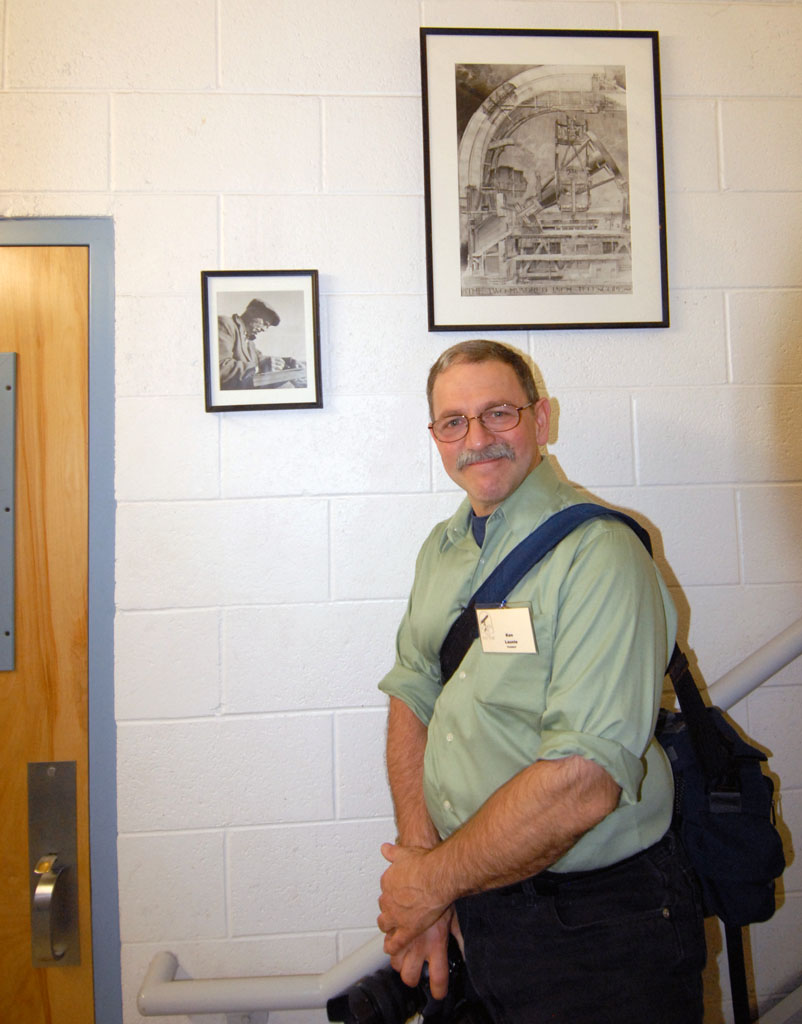
The University of Arizona's Mirror Lab has fabricated some of the largest professional telescope mirrors ever made. Hanging next to the main entrance is a photo of Russell Porter, and reproductions of Porter's drawings of the 200-inch Palomar telescope are hung along the adjacent stairway. It's nice to see Porter recognized this way for his pioneering work in telescope mirror making.
The photo at right was taken in October 2011 during a tour of the lab given to the Antique Telescope Society. Society president Ken Launie is shown in this photo by John Briggs.
Conventions
There is additional information about conventions on our Conventions Main Page including Historic Convention Programs, Historic Convention Photos and Winners of the Telescope Competition.
The 1925 Gathering
Preceding the first convention, this mid-June gathering was its forerunner. We have several photos and an article from the Springfield Reporter to document this event.

The Spark that Started Convention
1925 and 1926 were transformational years that would turn a sleepy local astronomy club into a world-wide ATM powerhouse.
Albert Ingalls' article about his visit to Stellar Fane ignited worldwide interest in Amateur Telescope Making, and the Springfield Telescope Makers were ready and able to share their knowledge and expertise with all those who shared this interest.
The 1926 Stellafane Convention
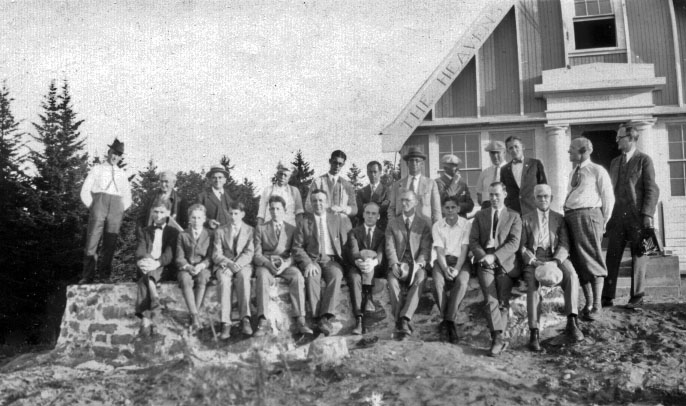
Excerpts from the report by Albert G. Ingalls in the September 1926 Scientific American of the first convention.
In this 1926 Convention photo Russell Porter & Albert Ingalls are at far right
Memoirs from the 1930 Stellafane Convention
by Leo Scanlon, edited by Bert Willard
Odyssey of a Wayward Telescope Nut
Jim Beaty describes his first Stellafane Convention (1966).
Observatories & Buildings
Stellafane Observatory National Historic Landmark
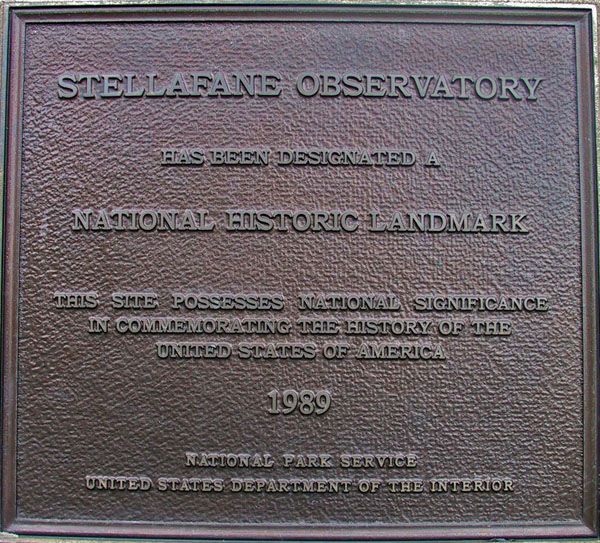
On December 20, 1989, the approximately 3.5 acre site on the summit of Breezy Hill, including the Stellafane Clubhouse and Porter Turret Telescope, were listed as a National Historic Landmark.
The Stellafane Observatory National Historic Landmark Plaque is on the rock base of the Porter Turret Telescope
Stellafane: Our Clubhouse
The Stellafane Clubhouse built in 1924, is notable in that it includes a Polar Cassegrain Telescope, Transit Telescope, Solar Telescope and South Wall Sundial. All of the instruments except the Transit Telescope are still operational. It also attracts attention because of its unique pink color. There are three rooms on the first floor: The fireplaced meeting room, the kitchen, and a workshop (which is now used as a kitchen extension). Upstairs, reached by a retractable stairway, are two rooms, originally used as bunkrooms, and now used for storage. Club meetings are still held here, except when snow prevents access in the winter months.
Read this 1927 article by Russell Porter in Popular Astronomy (PDF). The article describes the clubhouse, it's facilities and telescopes. "The establishment [clubhouse] is now completed...", "...securely anchored to the rock with steel cables.", "Electric lights were installed this year." and 'Stellafane has already had two conventions... In fact our conventions act very much like a clearing house for ideas relating to reflecting telescopes".
The Porter Sundial on the Stellafane Clubhouse
This article describes the Porter Sundial on the south wall of the Stellafane Clubhouse, and includes some very nice photographs of the instrument on a bright, sunny day.
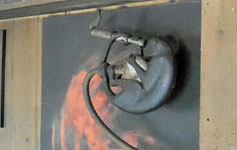
Rufus Guenon
Monkey of Supernatural Power
Rufus hangs above the clubhouse fireplace mantle.
Read about this tale of intrigue, kidnapping and good fun from the early days of Stellafane.
The Porter Turret Telescope
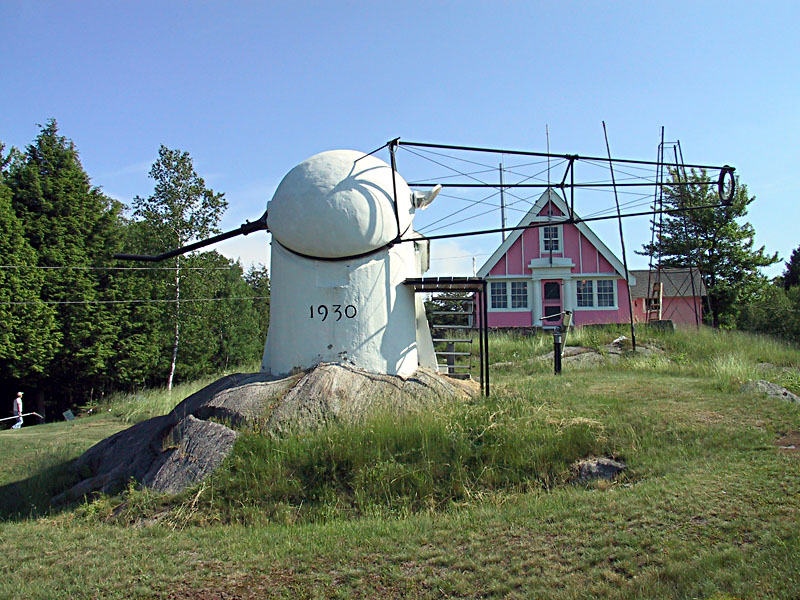
Stellafane Clubhouse, July 2003.
This unique 12-inch f/17 equatorial turret telescope is part of the Stellafane Observatory National Historic Landmark. Read about it's history, and see how we use it today:
- How it Works: The Porter Turret Telescope is just a modified Newtonian, with the diagonal before the primary. Learn how it works, and view a photo gallery of how the optics are installed before each use.
- Construction Photo Gallery: These images from the Stellafane archive show the Porter Turret Telescope being built.
- The Porter Turret Restoration, Present Status and Future Operation: An article by member Jim Daley describing the 1970's restoration of the instrument. It also includes an excellent photo of Mars taken in 2005 by Bert Willard with the Porter Turret Telescope.
- The Turret Gets New Roof In the spring of 2015, the roof of Porter Turret Telescope was replaced by a club work party.
The Clearing of Breezy Hill
In November 1982 loggers were hired to remove the forest that came right up to the back of the Stellafane clubhouse. This page has before and after pictures, and as a bonus, a photo of what was on Breezy Hill before Stellafane was built.
Historic Club Activities
See also Current Member Activities.
Bean Hole Beans
In the early 1970's the tradition of the Bean Hole beans was revived for awhile. Accounts of both the original 1934 Beans, and the 1970's revival with photographs are on this page.
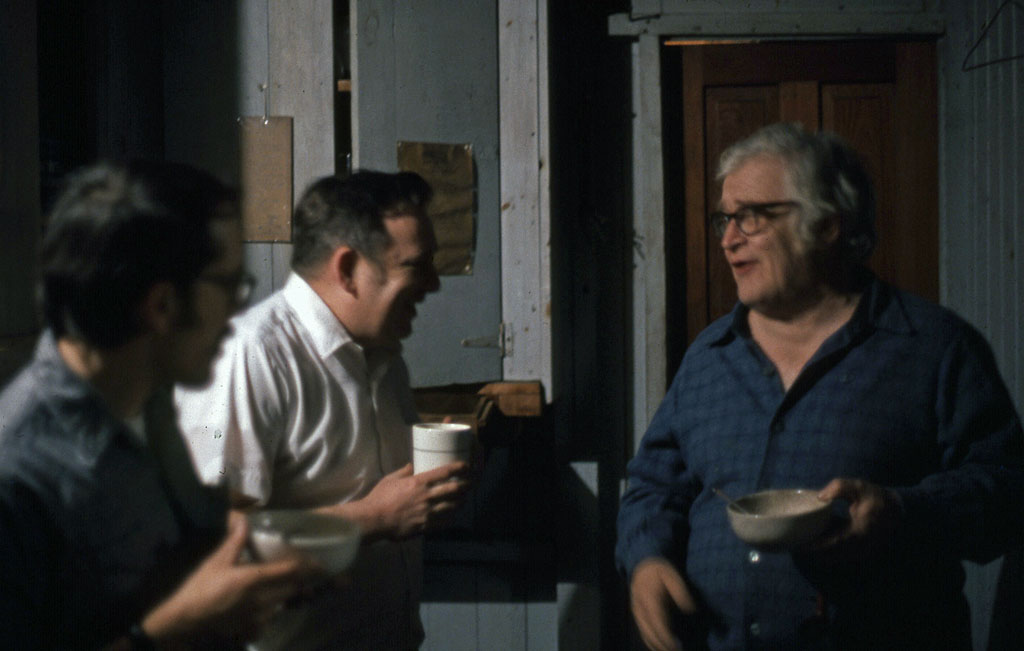
Friends in the Clubhouse, March 1973
Walt Wheeler, Carl Breuning and Walter Scott Houston enjoy some refreshment and conversation in the clubhouse kitchen on a March weekend in 1973. While most people experience Stellafane during convention, members spend a lot of time on the site working together to maintain the land, the buildings and equipment - and even observing if the Vermont weather allows. Shared work and quiet times like this build life-long friendships and a real sense of belonging.
Walt Wheeler - Walter Scott Houston Photos
Two of the club members in the photo at right - Walt Wheeler and Walter Scott Houston - owned a collection of interesting photos from major observatories. They have been donated to club and are available to view by clicking the link above.
Museum & Hartness
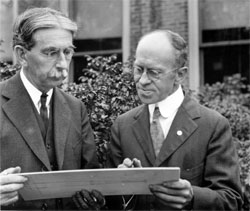
Hartness-Porter Museum
In 1975 we opened the Hartness - Porter Museum of Amateur Telescope Making in the underground rooms at the Hartness House Inn. Many items on display are shown in pictures in this virtual museum tour.
At right, James Hartness & Russell Porter
Springfield, VT, September 1920
100th Anniversary of the Completion of
the Hartness Turret Telescope
This article by club historian Bert Willard reviews the history and use of the Hartness Turret Telescope on the one hundredth anniversary of its completion in 2010.
The Turret Equatorial by James Hartness
This article by James Hartness in the Journal of the American Society of Mechanical Engineers (v 33:2, 1911) describes his invention and implementation of this type of telescope. Plenty of photos and drawings should you want to build your own! PDF, 30 pages, 5Mb.
Restoration of the Hartness Turret Telescope
This article by Jim Daley describes the restoration efforts of the Springfield Telescope Makers to keep the Hartness Equatorial Turret Refractor in good operating condition.
Ongoing Work on the Hartness Turret Telescope
Maintenance and improvement work continues to be done to this fine instrument. In this well isllustrated article by Dave Groski, he describes work done in the fall of 2012 and describes the plans for 2013.
Missing Porter Watercolor
A watercolor painting of the Porter Garden Telescope is missing from Stellafane. Please help us locate it.